
THE HAWAII I REMEMBER
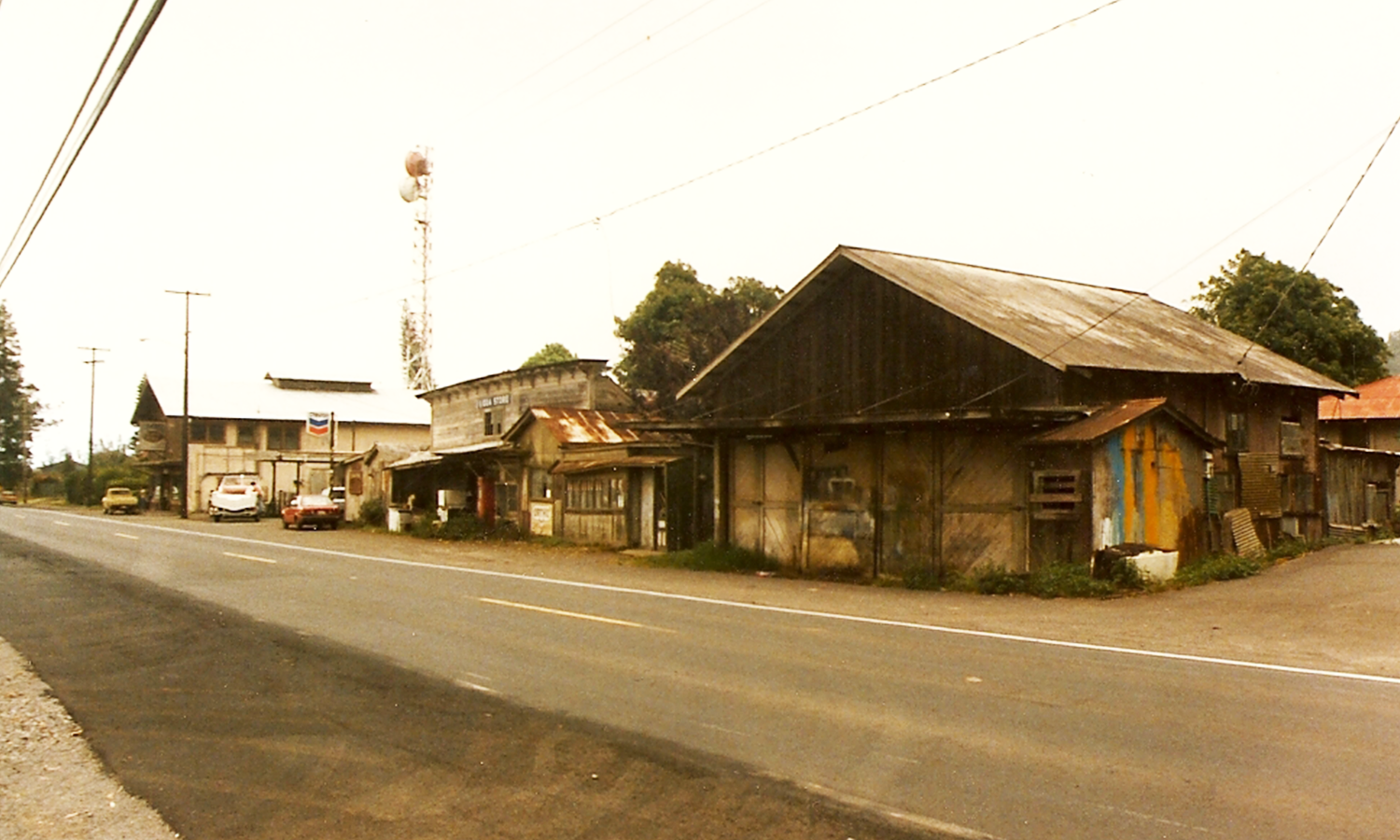
When I visited Hawaii as a child, I vividly remember how different the landscape was from Southern California. Of course, the topography and foliage were vastly different, but it was the architecture—the housing, the buildings, and the everyday dwellings—that really stood out to me.
Southern California had its own familiar visual language: stucco walls, tract homes, concrete driveways, garages, and neatly defined properties. Hawaii felt different. It felt more handmade.
Perhaps it was the ever-present moistness in the air that made everything seem more earthy. There was a dampness that carried the aroma of soil, vegetation, wood, and rain. It seemed to settle into everything. Buildings weathered differently. Wood aged differently. Even the air itself seemed to have a texture.
And then there were the structures.
Along the roads, I remember seeing what looked like garage-like buildings almost everywhere. Some were clearly businesses, while others appeared to be extensions of someone's home—a workshop, storage area, or perhaps a place where something was being built or repaired. They weren't necessarily polished or finished in the way buildings back home seemed expected to be. Many were simple structures assembled from wood and galvanized sheet metal, pieced together with practical ingenuity and the skilled hands of carpenters.
That image has stayed with me.
There was something distinctly midcentury Hawaii about those structures. They reflected a time when building something didn't necessarily mean hiring a large company or following a standardized plan. A person could take what materials were available, figure out what was needed, and make it work. Carpentry was a prominent occupation, and you could see the evidence of that craftsmanship throughout the islands.
As a child, I didn't have the vocabulary to explain why those buildings fascinated me. I simply knew they were different.
Looking back, I think what I was really noticing was a culture of making do, building up, and taking care of one's own.
My visits came during an important period in Hawaii's history. The islands were transitioning from their years as a U.S. Territory into statehood, and I had the opportunity to visit both the Big Island and Oahu during the state's early years. I was too young to fully appreciate the historical significance of that moment, but I could sense that I was experiencing a place with its own identity—one that wasn't simply an extension of the mainland.
What struck me most was the people.
There was a tight-knit quality to the communities I encountered. Island people seemed to take care of their own. Everyone seemed connected somehow—friends, relatives, neighbors, or friends of relatives. There was an ease in those relationships that felt very different from what I knew back home.
In Southern California, even as a child, the world could feel spread out. Neighborhoods were larger, roads were wider, and people could live remarkably close to one another without really knowing each other. Hawaii felt smaller in a different way. Not simply geographically, but socially.
People seemed to know people.
And people seemed to look after people.
That sense of community was perhaps the most striking difference of all.
The buildings I remembered—the little garages, workshops, sheds, and improvised structures—suddenly made more sense when viewed through that lens. They weren't just structures. They were part of a way of life. They were places where someone repaired something, stored something, built something, or perhaps ran a small business. They were evidence of people creating what they needed with what they had.
Years later, those childhood memories remain remarkably vivid.
I can still remember the humid air, the smell of the landscape, the lushness that seemed to surround everything, and those simple buildings tucked along the roads. But more than anything, I remember the feeling of being somewhere where community mattered.
Hawaii was different from Southern California in countless obvious ways. The mountains were different. The vegetation was different. The climate was different.
But what stayed with me wasn't simply the physical landscape.
It was the human landscape.
It was the feeling that behind every house, every workshop, every little roadside structure, there was a person—and behind that person was a family, a neighbor, a friend, and a community.
As a child, I simply noticed that Hawaii felt different.
As an adult, I think I understand why.