
YEAR OF THE RABBIT
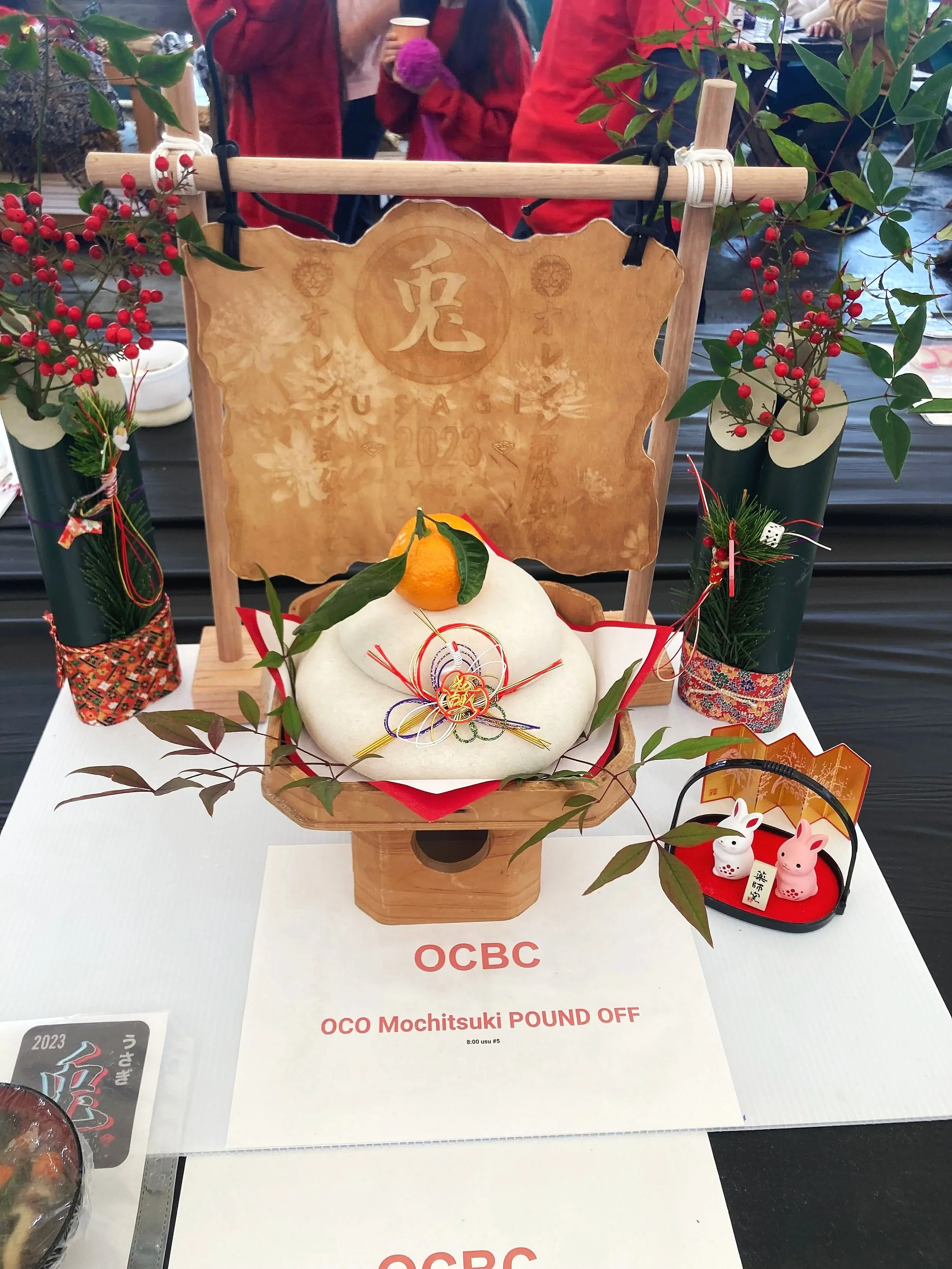
For many years, the OCO Club, a local service and sports nonprofit organization, and Tanaka Farms in Irvine have hosted an annual Mochitsuki Pound-Off contest to celebrate the Japanese New Year.
It’s a wonderful event that brings together tradition, competition, craftsmanship, and plenty of community spirit. And while the pounding of mochi is at the center of the celebration, there’s another creative challenge that takes place alongside it: designing and presenting the finished kagami mochi.
This year, Bento Box Studios was excited to be part of that challenge.
The Art of Mochitsuki
Mochitsuki is the traditional Japanese method of making mochi. Steamed glutinous rice is placed into a large stone mortar, or usu, where it is pounded with a heavy wooden mallet called a kine.
But it's not as simple as just pounding rice.
The process is a true team effort requiring collaboration, skill, cooperation, rhythm, and—perhaps most importantly—timing.
Several people work together to transform the hot, cooked rice into a smooth, sticky mass. The kine comes down with a powerful thump, while another person carefully turns and folds the rice between strikes. Everyone has to be in sync.
And there is a limited window of time to get it right.
Once the rice reaches the proper consistency, the shapers take over. With remarkably skillful hands, they work the warm, stretchy dough into smooth, round cakes.
These become kagami mochi, the traditional New Year's decoration consisting of two stacked rice cakes.
The word kagami means "mirror" in Japanese, and the two rounded cakes are traditionally placed one on top of the other, representing the shape of an old-fashioned Japanese mirror.
It's a deceptively simple form—but creating it beautifully takes considerable skill.
Designing the Display
The traditional colors of Japanese New Year—red and white—play an important role in the display, along with natural elements such as ferns and other plant cuttings.
The finished mochi is placed on a special wooden stand called a sanpo, creating the foundation for the New Year's decoration.
This is where Bento Box Studios entered the picture.
We designed and built a custom wooden backdrop to complete the display. We wanted the piece to provide a strong visual setting for the kagami mochi without competing with it.
At the center of the design is the beautiful calligraphy of Hiroko N., whose work became the focal point of the backdrop. We also etched a floral pattern across the entire piece, adding texture and a subtle decorative element while maintaining the natural character of the wood.
And Hiroko wasn't just the calligrapher.
She was also one of the talented mochi shapers!
That combination of artistic skills—calligraphy, food preparation, craftsmanship, and design—really captured the spirit of the event.
Less Is More
One of the interesting challenges of the competition is the size restriction.
There are plenty of elaborate and incredibly creative displays at the Pound-Off, but one of the most important rules is that the entire display must fit within a 2-foot by 2-foot plastic square sheet.
That limitation immediately became part of our design process.
Rather than trying to fill every inch or create something oversized and elaborate, our philosophy was simple:
The display should look proportional to the 2-by-2-foot space.
More importantly, the design should support the mochi—not overwhelm it.
The kagami mochi is the star of the display. Our job was to create a frame that gave it presence, complemented the traditional elements, and allowed the beauty of the mochi to remain the focal point.
In a competition where it's tempting to keep adding more—more decoration, more color, more elements—we chose restraint.
Sometimes, good design is knowing when to stop.
A Sweet Result
That approach turned out to be the right one.
We were thrilled to earn 1st Place in the "Old Farts" division! 🏆
Beyond the trophy, however, what made the experience special was being part of a tradition that brings so many different skills and people together.
Mochitsuki itself is built around teamwork. One person pounds. Another turns the rice. Others shape it. Still others prepare the decorations and presentation.
Everyone has a role.
Our project felt much the same way.
From Hiroko's beautiful calligraphy and her work shaping the mochi, to the traditional New Year's elements, to the woodworking and engraving that went into the backdrop, the final piece was the result of many hands and many talents coming together.
That's something we appreciate deeply at Bento Box Studios.
We love making things—but we especially love making things that have a story.
And this one came with a pretty sweet ending.
1st Place. Old Farts Division. Not bad for a couple of old wooden craftspeople. 😉
Happy New Year!
Akemashite omedetou gozaimasu! 🎍